CAPE Portal Phase 1 Launch Readiness: What Importers Must Do Before April 20, 2026
The CAPE portal goes live April 20, 2026. If your ACE account, ACH details, and broker coordination aren't in place by April 19, you won't get a refund on day one. Here's the operational readiness checklist.
CBP's Consolidated Administration and Processing of Entries (CAPE) portal goes live on April 20, 2026. It is the single biggest operational change to the IEEPA refund process since the program began — and if your ACE account, ACH details, and broker coordination are not in place by April 19, you will not receive a refund on day one.
This is the launch-day readiness checklist. If you've already read our CAPE portal step-by-step guide, this post is the operational layer on top: what to verify in ACE, what to line up with your broker, and how to avoid the 80-day liquidation trap that's about to start burning entries.
What is CAPE Phase 1, exactly
CAPE is a functionality inside the Automated Commercial Environment (ACE). It is not a standalone portal. You do not create a CAPE account. You log into ACE, navigate to the CAPE module, and file a CAPE Declaration — a single CSV that batches up to 9,999 entries worth of IEEPA refund requests at a time.
Phase 1 covers:
- Unliquidated entries with IEEPA duties paid
- Recently liquidated entries — specifically, entries that liquidated within the prior 80 days (still inside the reliquidation window)
Phase 1 does not cover:
- Entries that liquidated more than 80 days ago (those require a protest under 19 U.S.C. § 1514 or a CIT action)
- Section 232, Section 301, anti-dumping, or countervailing duties (CAPE is IEEPA-only in Phase 1)
⏰ The 80-day trap: Every day you wait after liquidation, more of your entries age out of Phase 1. Entries that liquidated in mid-January 2026 have already aged out. Entries that liquidated in early February 2026 will age out during the first week of CAPE going live. Pull your liquidation dates today.
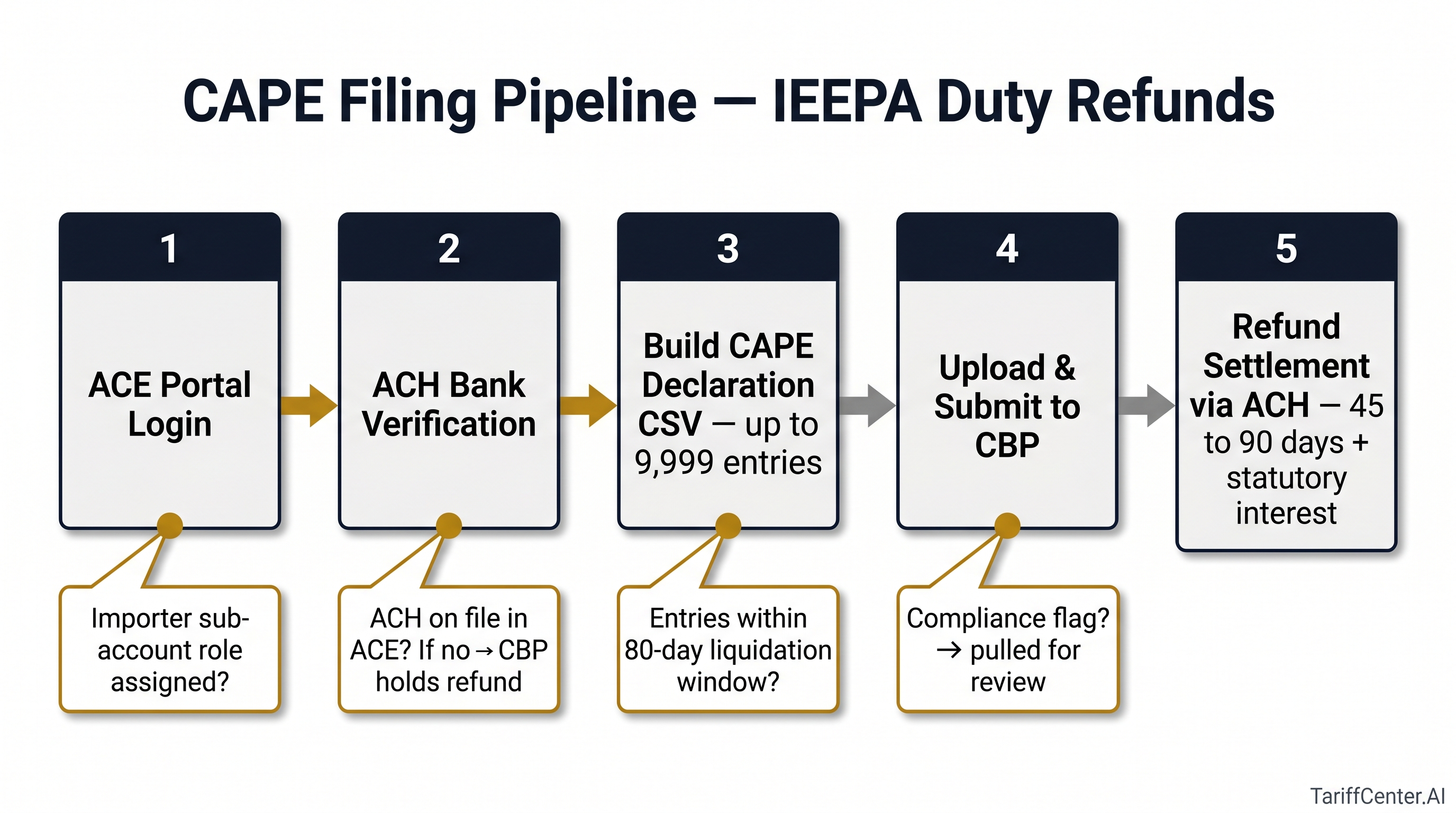
The CAPE filing pipeline
Here is what the end-to-end flow looks like from broker login to money in your bank. Decision branches are the places most importers get stuck.
Step 1 — ACE Portal login
The filer (importer of record or authorized broker) logs into the ACE Secure Data Portal using their existing ACE credentials. No new login, no new portal URL.
→ Decision point: Does the filer have the Importer sub-account enabled on their ACE profile? CAPE Declarations can only be filed from an account with the Importer role. If you use a broker, confirm their role assignment before April 20.
Step 2 — Bank account verification (ACH)
Before filing, the Importer sub-account must have current ACH bank account information registered in ACE. This is the single most common launch-day failure mode.
→ Decision point: Has the ACH bank account been added and verified in ACE? If not, CBP holds the refund until the account is provided — the Declaration is accepted but no money moves.
Step 3 — Build the CAPE Declaration CSV
The filer generates a CSV with the entries being consolidated for refund. Each row is one entry. Up to 9,999 rows per Declaration. Filers can submit multiple Declarations if they have more entries than that (very few SMBs do; some enterprise importers will).
→ Decision point: Which entries belong on this Declaration? Mixing non-IEEPA duties, or including entries outside the 80-day window, will cause the Declaration to be rejected or partially processed.
Step 4 — Upload and submit
The Declaration is uploaded through the ACE Portal and submitted to CBP. CBP validates the file against the entries-of-record.
→ Decision point: CBP may flag entries for compliance review (classification disputes, valuation concerns, origin questions). Those entries are pulled out of the automatic refund flow; the rest continue.
Step 5 — Acceptance and refund settlement
Once a Declaration is accepted, CBP's stated window is 60–90 days to settle refunds through ACH, plus statutory interest on amounts owed. Industry guidance suggests 45–90 days for clean Declarations with no compliance flags.
→ End state: Refund lands in the Importer's ACH account as a single consolidated payment per accepted Declaration, including interest.
The April 19 readiness checklist
Run this list with your broker or in-house customs team before close of business on April 19, 2026.
Inside ACE
- You have a live ACE Portal account
- You have the Importer sub-account role assigned
- Your ACH bank account is on file in ACE and marked as active
- You or your broker has tested logging in within the last 14 days
- You know who on your team has filing authority
Entry data
- You have pulled a list of all entries with IEEPA duties paid since April 2025
- Each entry is tagged with liquidation date and days since liquidation
- Entries within 80 days of liquidation are segmented for Phase 1 filing
- Entries more than 80 days past liquidation are segmented for protest filing (separate track)
- IEEPA duty amounts are reconciled against CBP's ACE data, not internal ledgers
Broker coordination
- You know whether your broker is filing the CAPE Declaration on your behalf or whether you will
- If the broker files: their ACE account is configured to see your entries
- If you file: you have the broker's assist on the CSV format
- Fees for CAPE filing are agreed in writing (most brokers are charging per-Declaration, not per-entry)
- Your broker's POA covers refund handling — older POAs may not
Internal accounting
- Finance knows refund payments will arrive as single consolidated ACH deposits per Declaration, not per entry
- Tax is briefed on the treatment of statutory interest (generally taxable income in the year received)
- Your ERP or accounting system has a line item coded for "IEEPA refund — CBP CAPE"
The 80-day clock, explained plainly
This is the part that trips up even experienced importers.
When CBP liquidates an entry, the entry becomes final unless you take action within statutory windows:
- Within 90 days: CBP can voluntarily reliquidate (including through CAPE Phase 1's 80-day eligibility rule)
- Within 180 days: the importer can file a protest under 19 U.S.C. § 1514
- After 180 days: protest is time-barred; CIT litigation may still be possible but is far more expensive
CAPE Phase 1 is essentially CBP granting itself a streamlined reliquidation pipeline for IEEPA duties on unliquidated entries and entries inside the 80-day window. Once the window closes on a given entry, that entry cannot come back through CAPE Phase 1, even if a later CAPE Phase 2 or 3 expands scope.
If you have high-value entries that liquidated in January or early February 2026, treat those as urgent protest filings, not CAPE candidates.
What about Section 301, Section 232, and antidumping refunds?
None of them are in Phase 1. CAPE Phase 1 is IEEPA-only.
CBP has publicly signaled an intent to expand CAPE to other remedy categories in later phases, but no dates are confirmed. Importers with Section 301 or Section 232 refund claims should:
- Continue using existing ACE processes
- Preserve protest rights on any entries liquidating now
- Watch for a CAPE Phase 2 announcement — it will likely come with its own 30–60 day readiness window
Where TariffCenter can help on launch day
For the next week, the fastest thing you can do is:
- Refund Estimator — back-of-envelope estimate of refund exposure
- Refund Readiness Checklist — the 10-step operational checklist, with progress tracking
- Refund Status Tracker — monitor CBP settlement timelines after filing
- AI Tariff Assistant — answer broker-coordination questions without waiting for a lawyer's callback
Bottom line
April 20 is not "the day you get your refund." April 20 is the day the CAPE door opens — and only for importers whose ACE accounts, ACH details, broker roles, and entry data are actually in order. Everything that can go wrong on launch day is something that can be fixed today.
If your ACE account is not set up, your ACH bank info is missing, your broker hasn't been briefed, or your entries aren't segmented by liquidation date, do those things before April 19. Treat this as a hard operating deadline, not a news date.